

Fashion & Apparel eCommerce benchmarks for 2026
Fashion & Apparel is one of the most visually driven categories in eCommerce, but it is also one of the hardest to measure cleanly.
A strong product image can create demand quickly. A good creator video can make a collection sell out. A seasonal drop can drive a large spike in revenue within a few days. On the surface, this makes Fashion & Apparel look like a category where growth is mostly about brand, creative, and paid media.
But the real economics are more complicated.
Fashion brands have to deal with sizing uncertainty, fit expectations, colour accuracy, high return rates, seasonal inventory risk, discount pressure, and creative fatigue. A campaign can look profitable before returns are processed. A product can sell well but create customer support pressure. A customer can place a large order but send half of it back.
That is why Fashion & Apparel benchmarks need to be read carefully.
Conversion rate, ROAS, AOV, LTV, cart abandonment, and repeat purchase rate are all useful metrics. But in this category, the numbers only make sense when they are connected to return rate, margin, merchandising quality, and how confident the customer feels before buying.
Why Fashion & Apparel performance is harder to read than revenue alone suggests
Fashion & Apparel revenue can be misleading because the order is not always the final outcome.
A customer may buy three sizes of the same dress and keep one. Another customer may order multiple outfits for one event and return most of them. A paid ads campaign may report strong revenue, but the net result can change after returns, exchanges, discounts, and fulfillment costs are included.
This is one of the main differences between Fashion & Apparel and categories with lower return friction.
In Food & Beverage, the main challenge is often turning trial into repeat purchase. In Health & Beauty, the challenge is usually trust, claims, education, and routine-building. In Fashion & Apparel, the challenge is creating enough confidence before purchase so the customer buys the right product, in the right size, for the right occasion.
That is why a brand can have strong demand and still struggle with profitability.
Fashion performance should not only be judged by how many orders a brand generates. It should be judged by how many of those orders stay sold, how often customers come back, how much margin remains after returns, and whether the brand can scale without relying too heavily on discounts.
Fashion & Apparel benchmark summary: conversion, AOV, LTV, CAC, and repeat purchase
General Fashion & Apparel benchmarks
| KPI | Fashion & Apparel benchmark |
|---|---|
| Conversion rate | 2.2–2.8% |
| Average order value | $85–$140 |
| LTV, 12-month estimate | $240–$450 |
| Cart abandonment | 75–80% |
| CAC estimate | $30–$60 |
| Repeat purchase rate | 25–45% |
Paid Ads Benchmarks
| Channel | ROAS | CPA |
|---|---|---|
| Meta Ads | 2.5–3.5x | $30–$55 |
| Google Ads | 2.8–4.2x | $25–$45 |
| TikTok Ads | 1.8–2.8x | $28–$50 |
Email Marketing Benchmarks for Fashion & Apparel Industry
| KPI | Fashion & Apparel benchmark |
|---|---|
| Campaign open rate | 30–36% |
| Campaign CTR | 1.6–2.4% |
| Flow open rate | 45–55% |
| Flow CTR | 4.5–7.5% |
| Email order rate | 0.08–0.14% |
| Revenue per recipient | $0.10–$0.20 |
Fashion & Apparel benchmarks vary widely depending on product type, price point, market, brand maturity, and customer segment.
A basics brand with low price points and frequent replenishment will behave very differently from a premium occasionwear brand. A luxury fashion brand will have different AOV, conversion, and purchase frequency compared with an activewear brand or fast fashion retailer.
Still, the benchmark ranges are useful because they show the pressure points that most Fashion & Apparel brands face.
Conversion rate is influenced by product photography, size guidance, product page quality, mobile UX, reviews, shipping terms, and return policy clarity.
AOV is shaped by merchandising, bundles, collection strategy, free-shipping thresholds, styling suggestions, and cross-sells.
LTV depends on whether the brand can turn first-time buyers into returning customers across seasons, collections, occasions, and style preferences.
CAC is affected by creative performance, product-market fit, seasonality, competitive ad auctions, and how well the brand converts paid traffic after the click.
Repeat purchase rate is where stronger Fashion & Apparel brands often separate themselves. They do not rely only on new customer acquisition. They create reasons for customers to come back through drops, new collections, styling inspiration, loyalty, customer segmentation, and lifecycle marketing.
Methodology note: how to use these benchmarks
These benchmarks should be treated as directional planning ranges, not fixed performance targets.
Fashion & Apparel performance can shift significantly based on subcategory, market, product price, discounting strategy, seasonality, return rate, and traffic mix. A women’s occasionwear brand, a streetwear brand, a premium basics brand, and an activewear brand should not all expect the same numbers.
The goal of this report is not to define one universal “good” benchmark for every fashion brand.
The goal is to help Fashion & Apparel operators understand what the numbers usually mean, where performance can be misleading, and which parts of the funnel deserve closer attention.
Benchmarks are most useful when they help a brand ask better questions:
Is our conversion rate low because traffic quality is weak, or because customers do not feel confident about fit?
Is our ROAS strong before returns but weak after returns?
Is our AOV healthy because customers are buying more, or because they are ordering multiple sizes and returning later?
Is our repeat purchase rate low because people do not like the product, or because we are not giving them enough reasons to come back?
That is the right way to read Fashion & Apparel benchmarks in 2026.
What Fashion & Apparel benchmarks reveal about growth quality
Fashion & Apparel growth quality depends on more than demand generation.
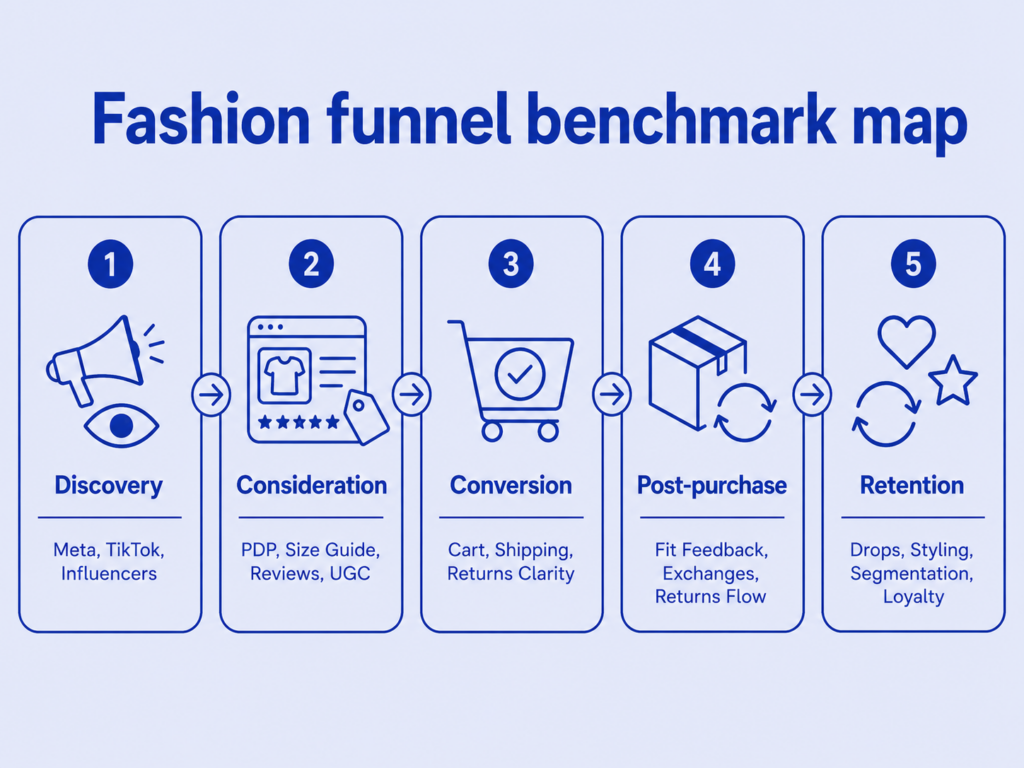
Demand is important, but demand alone does not guarantee profitable growth. A brand can generate strong traffic through Meta, TikTok, influencers, and Google Shopping, but still struggle if customers are unsure about size, fabric, fit, styling, or return terms.
The strongest Fashion & Apparel brands usually have three things working together.
First, they have strong visual demand creation. Their creative makes people want the product.
Second, they have strong purchase confidence. Their product pages, size guides, reviews, UGC, and email touchpoints reduce uncertainty before checkout.
Third, they have strong lifecycle systems. Their post-purchase, retention, winback, and collection launch flows help customers buy again without needing to be reacquired from scratch.
Weak brands often over-rely on acquisition. Stronger brands build systems that make each acquired customer more valuable over time.
That difference matters because fashion customers rarely buy only one product category forever. They move through seasons, occasions, preferences, sizes, styles, and budgets. Brands that understand this can build better segmentation, better product recommendations, and better repeat purchase paths.
Conversion rate benchmarks for Fashion & Apparel brands
Fashion & Apparel conversion rates are heavily affected by uncertainty.
A customer might love the product but hesitate because they are unsure how it fits. They may like the colour but wonder whether it looks different in natural light. They may want the item but worry about shipping times, return windows, fabric quality, or whether the product will look the same on their body as it does on the model.
This is why the Fashion & Apparel conversion rate cannot be improved only by changing button colours or shortening checkout steps.
Those things matter, but the bigger issue is often confidence.
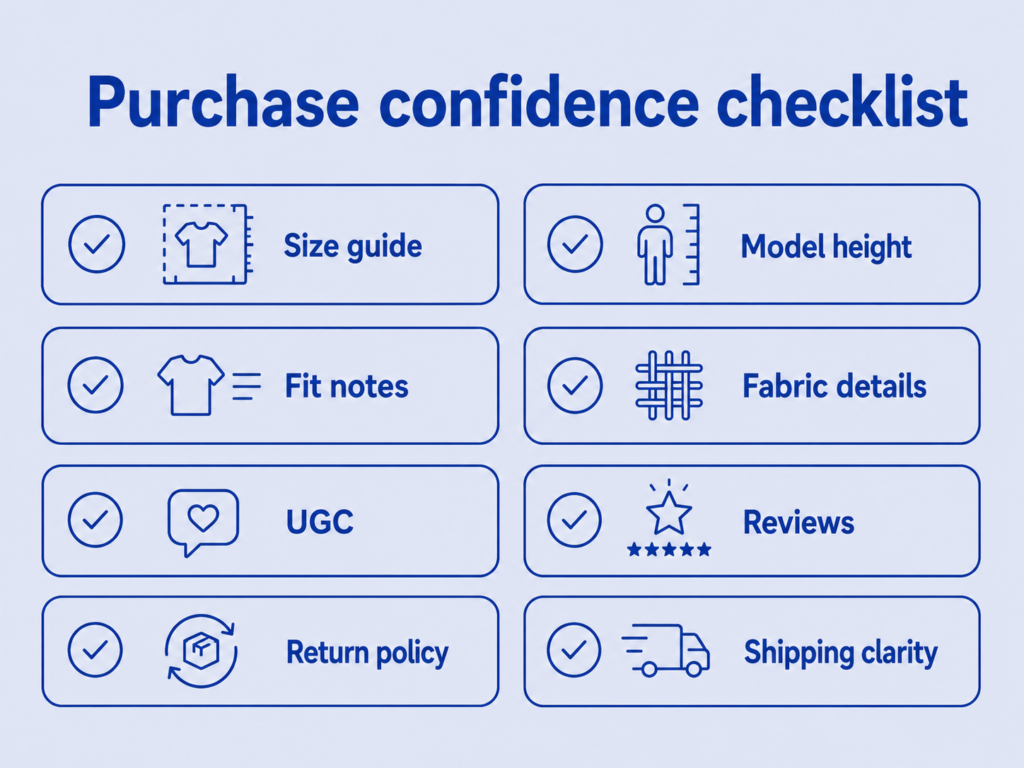
Strong fashion product pages usually include multiple model angles, fit notes, fabric details, size and height references, review content, UGC, shipping clarity, and return policy visibility. These details reduce the gap between expectation and reality.
According to Centra’s fashion conversion benchmark analysis, conversion rates vary significantly across fashion verticals, with accessories, women’s fashion, men’s fashion, and sportswear showing different performance patterns. This supports the idea that Fashion & Apparel should not be judged as one flat category.
For many brands, improving conversion rate means improving the customer’s ability to imagine the product accurately before buying.
Average order value benchmarks and why merchandising matters
Average order value in Fashion & Apparel is closely tied to merchandising.
AOV does not only increase because a brand raises prices. It can also increase when the shopping experience makes it easier for customers to build complete outfits, add matching items, qualify for free shipping, or discover relevant products from the same collection.
Fashion brands have a natural advantage here because products can be styled together.
A dress can be paired with accessories. Activewear can be sold as a set. Basics can be bundled by colour or quantity. Seasonal collections can be merchandised around events, travel, weather, or occasions.
The challenge is that AOV can also be misleading.
If customers frequently buy multiple sizes and return most of the order, gross AOV may look healthy while net revenue is weaker. This is why Fashion & Apparel brands should track AOV alongside return rate and net sales, not in isolation.
A strong AOV strategy should increase the value of orders that customers actually keep.
That can come from better bundles, clearer product pairing, styling content, personalised recommendations, and collection-based shopping paths. The goal is not just to make the cart bigger. The goal is to make the cart more relevant.
Customer lifetime value benchmarks in a trend-driven category
Fashion & Apparel LTV depends on how well a brand can turn one purchase into an ongoing relationship.
This is not always easy because fashion demand is seasonal, emotional, and trend-sensitive. A customer may love one collection but not the next. They may buy for a specific event and then disappear. They may change size, style, budget, or preference over time.
Because of this, fashion retention is less about replenishment and more about relevance.
A skincare brand can remind customers when they are likely to run out. A coffee brand can trigger reorder flows based on consumption timing. A fashion brand often has to work harder. It needs to understand style preferences, category interest, size, price sensitivity, occasion, purchase history, and timing.
Strong LTV in Fashion & Apparel usually comes from segmentation.
Customers who bought dresses should not always receive the same messaging as customers who bought everyday basics. Customers who bought during a sale may behave differently from full-price buyers. Customers who purchased occasionwear may need styling, event-based messaging, or new collection drops rather than generic promotional emails.
The more specific the lifecycle strategy, the more likely the brand is to increase repeat purchase without relying only on discounts.
Cart abandonment benchmarks and the role of sizing uncertainty
Cart abandonment is high across eCommerce, but in Fashion & Apparel it often has a specific cause: uncertainty.
The customer may want the product, but not enough to commit yet.
They may wonder:
Will this fit me?
Will the fabric look the same in person?
Is the colour accurate?
Can I return it easily?
Will it arrive before the event?
Is this worth the price?
Do other customers with my body type like it?
These questions create hesitation at the exact moment when the customer is close to buying.
A standard abandoned cart flow that only says “you left something behind” may recover some orders, but it does not solve the underlying problem. Fashion abandoned cart flows usually need more context.
They should reinforce fit guidance, reviews, UGC, shipping details, return policy clarity, and product benefits. Where possible, they should also show the product in real-life settings, not only polished campaign photography.
Envive’s fashion conversion statistics place fashion cart abandonment at 77.6%, which highlights how common this issue is in the category.
The brands that perform better usually do not treat cart abandonment as a reminder problem. They treat it as a confidence problem.
CAC benchmarks and the pressure on first-order profitability
Customer acquisition cost is one of the biggest pressure points for Fashion & Apparel brands.
The category is competitive, visually saturated, and heavily dependent on creative performance. Many brands are fighting for attention across the same paid channels, especially Meta, TikTok, Google Shopping, influencers, and creator-led content.
Creative fatigue can appear quickly.
A campaign angle that works one month may stop working the next. A best-selling product can lose momentum. A seasonal drop can perform strongly during launch week and then decline. This makes CAC more volatile than in categories with more stable intent or replenishment patterns.
Fashion brands also face a profitability challenge after acquisition.
If a new customer buys once, returns part of the order, and never comes back, even a reasonable CAC can become too expensive. If the same customer comes back across multiple collections, CAC becomes easier to justify.
That is why Fashion & Apparel brands should not judge acquisition only by first-order performance.
The better question is: which acquisition channels bring customers who keep their orders, buy again, and engage with the brand beyond the first purchase?
A lower CAC is useful, but a higher-quality customer can be more valuable than a cheaper one.
Repeat purchase benchmarks for Fashion & Apparel brands
Repeat purchase in Fashion & Apparel depends on timing, preference, and relevance.
Unlike Food & Beverage, where repeat purchase can be tied to consumption, fashion repeat purchase is often tied to newness, seasonality, occasions, identity, and lifestyle.
Customers return when they feel the brand continues to match who they are, what they need, and how they want to present themselves.
This means repeat purchase is not only a retention metric. It is also a merchandising, product development, and communication metric.
Strong fashion brands give customers reasons to come back:
- New collection drops
- Seasonal edits
- Back-in-stock alerts
- Style guides
- Personalised recommendations
- VIP access
- Occasion-based campaigns
- Product care education
- Loyalty and early access
- Post-purchase content
The goal is to make the second purchase feel natural, not forced.
Fashion brands with weak repeat purchase often make one of two mistakes. They either only email customers when there is a sale, or they send generic campaigns that do not reflect what the customer bought, browsed, or showed interest in.
Better retention comes from understanding the customer’s style journey.
How Meta, Google, and TikTok play different roles in Fashion & Apparel acquisition
Meta, Google, and TikTok should not be treated as interchangeable channels.
They influence different customer moments.
Meta Ads are often strongest when the brand has strong visual identity, clear product angles, and enough creative volume to test different messages. For Fashion & Apparel, Meta creative often needs to show the product in motion, on different body types, in different contexts, and with a clear reason to buy now.
Google Ads capture more active demand. A customer searching for a black midi dress, linen summer set, leather tote, or wedding guest outfit is already closer to purchase. For fashion brands, Google performance depends heavily on product feed quality, pricing, images, product titles, reviews, and landing page relevance.
TikTok Ads can help brands create discovery, but the creative has to feel native. Try-on videos, styling content, creator reactions, outfit transitions, behind-the-scenes product stories, and “how I would style this” formats usually fit the platform better than traditional product ads.
Fashion acquisition works best when the channels are connected.
TikTok and Meta can create desire. Google can capture intent. Email and SMS can recover hesitation. Retention can turn one purchase into future purchases.
The strongest brands do not ask which channel is best in isolation. They ask what role each channel should play in the customer journey.
Email marketing benchmarks for Fashion & Apparel brands
Email marketing is especially important in Fashion & Apparel because it can do more than promote discounts.
It can reduce purchase uncertainty.
It can explain fit, fabric, sizing, styling, care instructions, and product use cases. It can help customers understand what to expect before buying. It can support post-purchase satisfaction after the order arrives. It can encourage exchanges instead of refunds. It can turn collection launches into repeat purchase moments.
Fashion email marketing should be visual, but not empty.
The best campaigns usually combine strong imagery with a clear reason to care. A new collection email should not only show products. It should explain the occasion, styling angle, seasonal relevance, or what makes the drop worth attention.
Flows are equally important.
Welcome flows can introduce brand positioning and best sellers.
Browse abandonment flows can reframe product benefits and show social proof.
Cart abandonment flows can address hesitation.
Post-purchase flows can reduce confusion and set expectations.
Winback flows can bring customers back around new collections, seasonal needs, or personalised recommendations.
Back-in-stock and price-drop flows can capture existing demand.
In Fashion & Apparel, email is not just a revenue channel. It is a confidence channel.
Why returns make Fashion & Apparel benchmarks harder to interpret
Returns are one of the biggest reasons Fashion & Apparel benchmarks are hard to read.
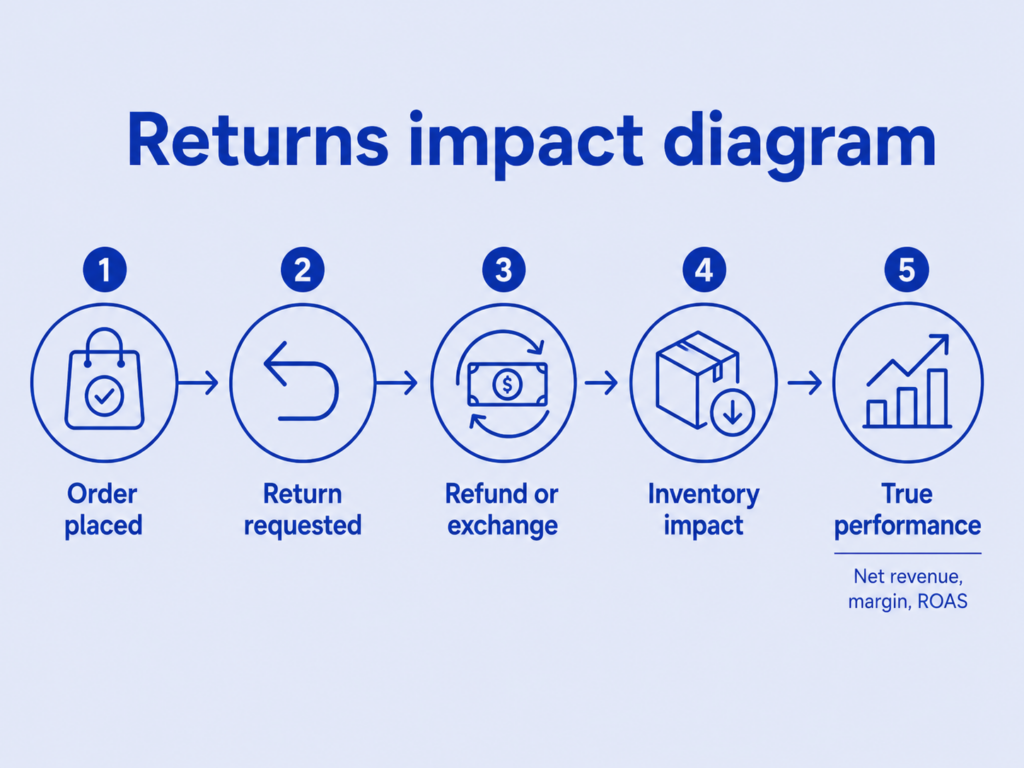
A brand can have a strong conversion rate, strong AOV, and strong ROAS, but if a large share of orders are returned, the real performance looks different. Returns affect net revenue, inventory reliability, customer support workload, fulfillment costs, cash flow, and the accuracy of marketing decisions.
This is especially important because Fashion & Apparel has some of the highest return rates in eCommerce.
Eightx’s 2026 ecommerce return rate analysis places Apparel and Fashion return rates around 20% to 30%, with variation by subcategory. Prime AI’s clothing return benchmark analysis similarly reports high apparel return rates and highlights differences across product categories and countries.
A useful example comes from Retention Side’s published case study with Eliya The Label, a women’s fashion brand. The case study explains how try-on-at-home behaviour, sizing uncertainty, and return-heavy purchasing created operational pressure and made channel metrics less reliable.
Retention Side connected PostCo return events with Klaviyo, rebuilt return-related flows, added UGC-driven email content, used customer survey insights to address common objections, and redesigned campaigns around more visual product education. The reported result was an 8% reduction in order return rate.
The important lesson is not that email alone solves returns.
The lesson is that returns are often a communication problem before they become an operations problem.
If customers do not understand fit, fabric, sizing, styling, or product expectations before buying, returns become more likely. If post-purchase communication is generic, brands also miss opportunities to encourage exchanges, store credit, or better product decisions in the future.
In Fashion & Apparel, reducing returns should not mean making returns harder. It should mean helping customers buy better.
How stronger Fashion & Apparel brands reduce purchase uncertainty before checkout
Stronger Fashion & Apparel brands reduce uncertainty before the customer reaches checkout.
They do this through product page content, email, UGC, reviews, sizing tools, model references, product photography, and clear merchandising.
A strong product page usually answers practical questions:
What size is the model wearing?
How tall is the model?
Does this run small, true to size, or oversized?
What does the fabric feel like?
Is it structured, stretchy, sheer, lined, heavy, or lightweight?
What occasion is this best for?
How should it be styled?
What do real customers say about fit?
How easy are returns or exchanges?
These details may seem small, but they directly affect conversion and return behaviour.
Fashion customers are not only buying an item. They are buying how they expect to feel in that item. If the brand creates a gap between expectation and reality, the customer may still buy, but the return risk increases.
That is why UGC and real customer visuals matter so much.
Studio photography creates aspiration. UGC creates realism. Brands need both.
The best Fashion & Apparel brands use pre-purchase content to help customers make better decisions, not just faster decisions.
What stronger Fashion & Apparel brands do differently
Fashion & Apparel brands that outperform category averages usually have stronger systems across creative, merchandising, conversion, and retention.
They do not depend on one channel or one campaign type.
They build a growth system where each part of the funnel supports the next.
Strong brands usually have:
Clear product positioning
Consistent creative testing
Strong mobile product pages
Detailed sizing and fit guidance
UGC across ads, PDPs, and emails
A strong review collection strategy
Relevant email segmentation
Post-purchase education
Collection-based retention campaigns
Better reporting around returns and net revenue
They also avoid one of the most common fashion growth mistakes: scaling acquisition before fixing purchase confidence.
If customers are unsure before buying, more traffic can create more problems. More abandoned carts. More support questions. More returns. More unreliable revenue reporting.
The strongest brands solve for clarity before scale.
They make the buying decision easier, more informed, and more emotionally convincing.
5 agency types Fashion & Apparel brands may need in 2026
Fashion & Apparel brands do not all need the same type of agency.
A premium brand with high AOV and return issues has different needs from a fast-growing activewear brand with creative fatigue. A brand with strong traffic but low conversion has different needs from a brand with strong first purchase but weak repeat purchase.
These are the five agency types most relevant to Fashion & Apparel brands in 2026.
1. Paid social and creative strategy agency
A paid social and creative strategy agency helps Fashion & Apparel brands test angles, improve creative output, and scale customer acquisition across channels like Meta and TikTok.
Fashion paid social depends heavily on creative quality.
The product has to be shown in a way that feels desirable, relevant, and believable. Static studio shots are often not enough. Brands usually need try-on content, creator videos, styling hooks, outfit transitions, UGC, social proof, and seasonal campaign concepts.
A strong paid social agency should understand both media buying and creative strategy. In Fashion & Apparel, creative is not just an asset for ads. It is the main driver of demand.
2. Email marketing and retention agency
An email marketing and retention agency helps Fashion & Apparel brands increase repeat purchase, improve lifecycle communication, recover abandoned carts, and make customer journeys more personalised.
This is especially important in fashion because customers behave differently based on style preference, product category, size, price point, purchase timing, and buying intent.
A good retention agency can help with welcome flows, browse abandonment, cart abandonment, post-purchase flows, winback, collection launches, segmentation, product recommendations, back-in-stock flows, and VIP customer journeys.
The best retention work in fashion does not only push promotions. It helps customers understand products better and gives them stronger reasons to come back.
3. Google Ads and shopping feed agency
A Google Ads and shopping feed agency helps Fashion & Apparel brands capture high-intent demand through Shopping, Performance Max, branded search, non-branded search, and product-led campaigns.
This is especially useful when customers are already looking for a product type.
For example, searches around wedding guest dresses, linen trousers, black boots, gym sets, winter coats, or designer-inspired accessories show active buying intent.
Google performance depends heavily on product feed quality. Titles, images, product categories, pricing, reviews, availability, and landing page relevance all matter.
A strong Google Ads agency can help fashion brands capture existing demand more efficiently instead of relying only on social discovery.
4. CRO agency
A CRO agency helps Fashion & Apparel brands improve the website experience so more visitors become buyers.
In fashion, CRO is not only about checkout friction. It also includes product page structure, mobile UX, size guide visibility, model information, review placement, product photography, cross-sells, shipping clarity, and return policy communication.
A CRO agency can be especially valuable when traffic volume is already meaningful, but the conversion rate is lower than expected.
The best CRO work in fashion focuses on reducing hesitation.
If customers need to leave the product page to understand sizing, fabric, shipping, or returns, the page is probably not doing enough.
5. Influencer, UGC, and content production agency
Influencer, UGC, and content production agencies help Fashion & Apparel brands create the content needed for ads, product pages, email, organic social, and collection launches.
Fashion is a visual category, but polished brand photography is not always enough.
Customers often want to see how products look on real people, in real settings, and across different body types. Creator content can make products feel more tangible and easier to imagine.
This type of agency can support try-on hauls, styling videos, creator partnerships, seasonal shoots, social proof content, and product education assets.
For fashion brands, content production is not only a brand activity. It supports conversion, paid media, retention, and return reduction.
Final takeaway: Fashion growth depends on confidence, not just demand
Fashion & Apparel brands do not struggle because customers are uninterested in fashion.
They struggle because attention is expensive, trends move quickly, returns distort performance, and customers often need more confidence before buying.
The brands that win in 2026 will not only be the brands with the best ads or the biggest collections.
They will be the brands that create desire, reduce uncertainty, and turn customers into repeat buyers.
That means better creative. Better product pages. Better sizing guidance. Better UGC. Better email flows. Better post-purchase communication. Better segmentation. Better reporting around net revenue and returns.
In Fashion & Apparel, profitable growth depends on helping customers make the right purchase, not just pushing them to make a purchase.
FAQ
What is a good conversion rate for Fashion & Apparel eCommerce brands in 2026?
A good conversion rate for Fashion & Apparel brands depends on product type, price point, traffic source, and brand maturity. Accessories, women’s fashion, men’s fashion, activewear, luxury, and fast fashion can all perform differently. In general, brands should compare conversion rate against similar product categories rather than broad eCommerce averages. Fashion conversion is heavily influenced by sizing clarity, product photography, reviews, UGC, mobile UX, shipping information, and return policy confidence.
Why do Fashion & Apparel brands often have high cart abandonment rates?
Fashion & Apparel brands often have high cart abandonment rates because customers hesitate before committing to size, fit, colour, fabric, delivery timing, and return terms. A shopper may like the product but still feel unsure whether it will look the same in person or fit the way they expect. Strong abandoned cart flows should address those objections with fit guidance, reviews, UGC, shipping clarity, and product-specific reassurance, not only a generic reminder or discount.
How do return rates affect Fashion & Apparel marketing benchmarks?
Return rates make Fashion & Apparel benchmarks harder to interpret because gross revenue does not always reflect net performance. A campaign can show strong ROAS before returns are processed, but the real profitability may be weaker after refunds, exchanges, restocking costs, and support workload are included. Brands should review conversion rate, AOV, ROAS, LTV, and repeat purchase rate alongside return rate and net revenue.
Which paid ads channel works best for Fashion & Apparel brands?
There is no single best paid ads channel for every Fashion & Apparel brand. Meta is often strong for visual discovery and creative testing. TikTok can help with creator-led demand and trend-driven products. Google is useful for capturing high-intent product searches through Shopping, Performance Max, and search campaigns. The best channel depends on the brand’s product type, creative quality, price point, margin, and whether the goal is demand creation or demand capture.
How can Fashion & Apparel brands improve repeat purchase rate and LTV?
Fashion & Apparel brands can improve repeat purchase rate and LTV by making lifecycle marketing more relevant. This includes segmenting customers by product category, style preference, size, purchase history, discount behaviour, and collection interest. Strong brands use email and SMS to promote new drops, back-in-stock products, styling ideas, seasonal edits, loyalty rewards, and personalised recommendations. The goal is to give customers a reason to come back beyond discounts.