

Health & Beauty eCommerce in 2026: trust, education, and repeat purchase
Health & Beauty remains one of the strongest eCommerce categories going into 2026, but it is also becoming harder to win in. The category benefits from clear consumer demand, repeat purchase behavior, and a strong emotional connection. At the same time, competition is rising across skincare, cosmetics, hair care, supplements, wellness, and personal care.
The biggest shift is that consumers are no longer buying only because a product looks good in an ad. They are comparing ingredients, reading reviews, watching product demonstrations, checking brand credibility, and expecting more education before they convert.
Health & Beauty in 2026 should not be treated as an easy-growth category anymore. Demand is still strong, but shoppers are more selective, harder to impress, and more careful about which brands they trust. That puts more pressure on brands to explain their value clearly, not just present the product attractively, a shift that is also reflected in McKinsey’s State of Beauty report on how the beauty category is evolving.
That matters because Health & Beauty brands are often judged on more than price. Customers want trust, visible outcomes, clear product explanations, and a reason to believe the brand is worth staying with. This is why the category can show strong conversion and repeat purchase benchmarks, but also high cart abandonment and rising acquisition pressure.
Health & Beauty benchmark summary for 2026
The following benchmarks show how Health & Beauty brands perform across general eCommerce KPIs, paid ads, and email marketing.
General Health & Beauty benchmarks
| KPI | Health & Beauty benchmark |
|---|---|
| Conversion rate | 4.5–4.6% |
| Average order value | $60–$164 |
| LTV, 12-month estimate | $220–$380 |
| Cart abandonment | 80.9% |
| CAC estimate | $28–$55 |
| Repeat purchase rate | 35–50% |
Paid ads benchmarks
| Channel | ROAS | CPA |
|---|---|---|
| Meta Ads | 3.0–3.5x | $32–$42 |
| Google Ads | 2.8–3.8x | $22–$32 |
| TikTok Ads | 3.2–3.5x | $22–$32 |
Email marketing benchmarks
| KPI | Health & Beauty benchmark |
|---|---|
| Campaign open rate | 30.5% |
| Campaign CTR | 1.4–2.2% |
| Flow open rate | 46–54% |
| Flow CTR | 5.0–8.0% |
| Email order rate | 0.09–0.12% |
| Revenue per recipient | $0.10–$0.18 |
Methodology note: These benchmarks are aggregated from publicly available eCommerce benchmark reports, platform-level performance data, agency observations, and category-specific research. They should be used as directional planning ranges, not fixed performance targets.
These numbers should be read as category averages, not as upper limits. They show where an average Health & Beauty brand may sit, but stronger brands can outperform these ranges when creative, offer strategy, lifecycle marketing, landing pages, and retention systems are managed properly.
General Health & Beauty marketing benchmarks
Health & Beauty has one of the strongest general benchmark profiles among eCommerce industries. The category combines emotional buying triggers with practical product needs. A customer may buy a skincare product because of a specific concern, a hair product because of a recurring routine, or a wellness product because it fits into a lifestyle goal.
This creates a good foundation for both conversion and repeat purchase. However, the same category also has a high level of skepticism. Customers often want proof before buying, especially when products promise visible results or are used on the body.
That is why the Health & Beauty benchmark profile looks strong, but not effortless. The conversion rate is high, repeat purchase potential is strong, and LTV is meaningful, but cart abandonment remains above 80%.
Conversion rate benchmark: why Health & Beauty converts above many other categories
The Health & Beauty conversion rate benchmark sits at 4.5–4.6%, which is strong compared with many other eCommerce categories.
There are a few reasons for this.
First, the buying intent is often specific. Customers are not always browsing casually. They may be looking for a moisturizer, serum, shampoo, supplement, routine, or beauty product that solves a particular need.
Second, Health & Beauty products usually have a lower decision barrier than high-ticket categories like jewelry, furniture, or electronics. A customer may still need trust, but the purchase often feels easier because the initial order value is not extremely high.
Third, the category benefits from strong emotional motivation. Beauty, confidence, wellness, self-care, and personal improvement are all powerful buying drivers.
Still, a high category conversion rate does not mean every brand converts easily. Product pages need to answer objections quickly. Ingredient information, usage instructions, reviews, before-and-after content, guarantees, and trust signals can all have a direct impact on whether the customer moves from interest to purchase.
AOV benchmark: what the $60–$164 range says about product mix
Health & Beauty AOV ranges from $60 to $164, which is a wide spread. This range usually reflects differences in product category, pricing model, and merchandising strategy.
A skincare brand selling a single cleanser will naturally sit lower than a brand selling full routines or bundles. A cosmetics brand may increase AOV through shade sets, seasonal collections, or limited drops. A wellness brand may increase order value through monthly supply packs, subscriptions, or goal-based bundles.
For Health & Beauty brands, AOV is rarely just about pushing customers to spend more. It is often about helping them buy the right routine.
That is why bundles, quizzes, regimen builders, “complete the routine” sections, and educational product recommendations can work well in this category. They increase order value while still feeling useful to the customer.
LTV and repeat purchase: why retention is one of the biggest growth levers
The 12-month LTV estimate for Health & Beauty sits at $220–$380, while the repeat purchase rate ranges from 35–50%.
This is where the category becomes especially interesting. Many Health & Beauty products are naturally replenishable. Skincare runs out. Supplements are consumed regularly. Hair care products become part of a routine. Cosmetics are repurchased, replaced, or expanded through new shades and seasonal launches.
This gives Health & Beauty brands more room to grow from existing customers than categories built mostly around one-time purchases.
The challenge is that retention does not happen automatically. Customers need reminders, education, replenishment prompts, cross-sell logic, loyalty incentives, and product discovery after the first purchase.
The retention opportunity in Health & Beauty is also being shaped by a wider shift toward routines, wellness, and long-term self-care. Customers are not only buying isolated products. They are building habits around skin, hair, body, supplements, recovery, and prevention, which also aligns with Euromonitor’s consumer health outlook into 2026.
Cart abandonment benchmark: why consideration still matters before checkout
Health & Beauty cart abandonment is 80.9%, which shows that even with strong conversion potential, many shoppers still hesitate before completing checkout.
This can happen for several reasons:
- The customer is still comparing options.
- They are unsure whether the product is right for them.
- They want to check reviews.
- Shipping costs or delivery timelines create friction.
- They are waiting for a discount.
- They need more proof before buying.
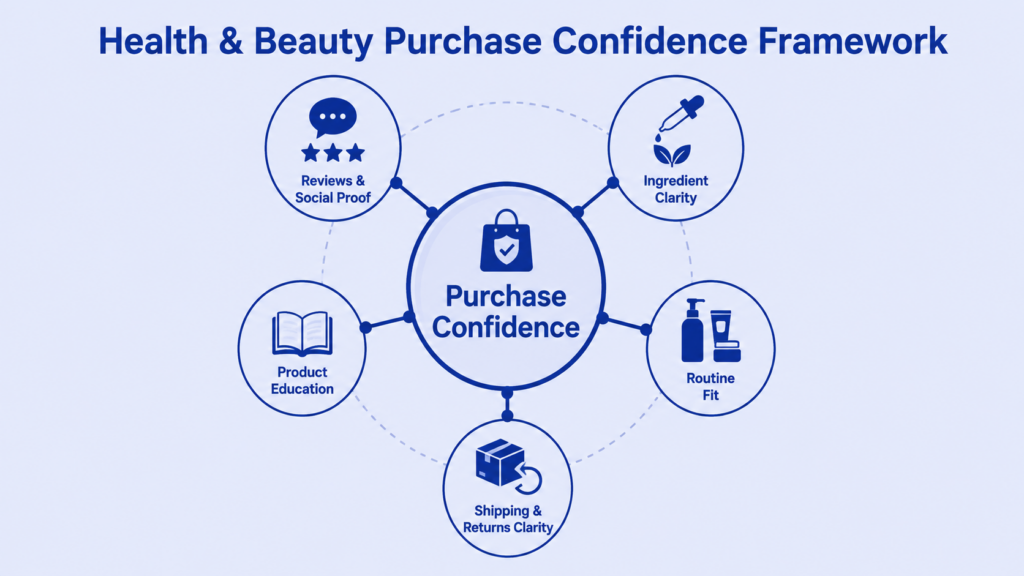
In Health & Beauty, abandoned carts are often not just price objections. They are confidence objections.
A strong abandoned cart flow should not only say “complete your order.” It should remind the customer why the product fits their need, reinforce reviews or product benefits, and reduce uncertainty. For higher-consideration products, brands may need more than one reminder. The first message can focus on the product left behind, while later messages can bring in education, social proof, FAQs, or a limited incentive.
Paid ads benchmarks for Health & Beauty brands
Paid ads remain important for Health & Beauty brands in 2026, but the way performance should be interpreted is changing.
The category has strong potential on Meta, Google, and TikTok, but each channel plays a different role. Meta is often strongest for visual creative testing and demand generation. Google captures more active intent. TikTok can create discovery and cultural momentum, but only when the creative feels native to the platform.
The role of paid social is also expanding beyond simple traffic acquisition. For Health & Beauty brands, platforms like Meta and TikTok are increasingly part of the discovery journey itself. Customers may first see a product through a creator, then compare reviews, visit the site, return through retargeting, and finally purchase after seeing more proof. That wider shift toward shopping behavior inside social platforms is also visible in Grand View Research’s social commerce market analysis.
For Health & Beauty brands, this matters because discovery is increasingly happening inside content environments, not only through traditional search.
Meta Ads benchmarks: strong creative can still drive profitable acquisition
Health & Beauty Meta Ads benchmarks sit at:
| KPI | Benchmark |
|---|---|
| Meta ROAS | 3.0–3.5x |
| Meta CPA | $32–$42 |
Meta remains a strong channel for Health & Beauty because it gives brands room to test visual angles, emotional hooks, founder-led content, UGC, routine education, and product demonstrations.
However, Meta performance depends heavily on creative quality. A basic product image with generic benefit copy is unlikely to perform consistently in a competitive category. Customers have seen too many similar beauty ads, skincare claims, supplement promises, and wellness hooks.
The strongest Health & Beauty brands usually treat creative testing as a system. They test different angles such as:
- Problem and solution
- Routine transformation
- Ingredient education
- Founder story
- Social proof
- Expert explanation
- Before-and-after style positioning, where compliant
- Product comparison
- Bundle value
The benchmark ROAS range is useful, but it should not be judged in isolation. A brand with stronger repeat purchase and better LTV may be able to tolerate a higher CPA than a brand that depends mostly on first-order profit.
Google Ads benchmarks: high-intent search remains valuable for product-led demand
Health & Beauty Google Ads benchmarks sit at:
| KPI | Benchmark |
|---|---|
| Google ROAS | 2.8–3.8x |
| Google CPA | $22–$32 |
Google can be especially valuable when customers already know what they are looking for. In Health & Beauty, this could include searches around product type, concern, ingredient, brand name, or comparison.
Google Ads often performs differently from Meta or TikTok because it captures active demand instead of creating it from scratch. Someone searching for a specific skincare concern, hair treatment, supplement type, or beauty product may already be closer to purchase.
That said, Google performance can become inefficient if the account structure is too broad. Health & Beauty brands should usually separate branded search, non-branded search, Shopping campaigns, Performance Max, and high-intent product groups. Otherwise, blended ROAS can hide where performance is actually coming from.
A high Google ROAS may be driven mostly by branded traffic. A weaker ROAS may still contain valuable new customer acquisition if non-branded campaigns are bringing in first-time buyers. The real question is not only “what is the ROAS?” but “what type of demand is this channel capturing?”
TikTok Ads benchmarks: discovery works, but only with the right creative system
Health & Beauty TikTok Ads benchmarks sit at:
| KPI | Benchmark |
|---|---|
| TikTok ROAS | 3.2–3.5x |
| TikTok CPA | $22–$32 |
TikTok is highly relevant for Health & Beauty because the platform naturally supports product discovery, tutorials, routine content, demonstrations, and creator-led recommendations.
However, TikTok is not simply another placement for Meta-style ads. Content that looks too polished or too much like a traditional ad may struggle. The channel often rewards creative that feels fast, specific, native, and useful.
For Health & Beauty brands, TikTok can work well when creative answers questions like:
What problem does this solve?
How do you use it?
What makes it different?
What does the routine look like?
Who is it best for?
Why are people talking about it?
TikTok is especially important because Health & Beauty content naturally fits the way people discover products through short-form video. Tutorials, routines, product comparisons, creator reviews, and “how I use it” content can reduce uncertainty before a shopper ever reaches the product page, a pattern also visible in NIQ’s beauty and personal care research around digital commerce and TikTok Shop.
This supports a bigger point: TikTok should not only be viewed as an ads channel. For some Health & Beauty brands, it is becoming part of the discovery, education, influencer, affiliate, and commerce ecosystem.
Why CAC pressure changes how Health & Beauty brands should judge ROAS
The Health & Beauty CAC benchmark is $28–$55.
This range may look manageable, but the real meaning depends on margin, AOV, subscription rate, repeat purchase rate, and 12-month LTV.
A brand with a $60 AOV and low repeat purchase rate will need much tighter acquisition economics than a brand with a $140 AOV, strong subscriptions, and a high second-purchase rate.
This is why Health & Beauty brands should avoid judging paid ads only by first-purchase ROAS. The better question is how acquisition connects to retention.
If a brand acquires customers profitably but does not bring them back, it will constantly need to replace lost customers with more paid traffic. If a brand has a strong post-purchase system, the same CAC can become much more sustainable.
Email marketing benchmarks for Health & Beauty brands
Email is one of the most important channels for Health & Beauty brands because it supports education, replenishment, routine-building, product discovery, and repeat purchase.
The benchmark numbers are:
| KPI | Health & Beauty benchmark |
|---|---|
| Campaign open rate | 30.5% |
| Campaign CTR | 1.4–2.2% |
| Flow open rate | 46–54% |
| Flow CTR | 5.0–8.0% |
| Email order rate | 0.09–0.12% |
| Revenue per recipient | $0.10–$0.18 |
These numbers show a clear difference between campaigns and flows. Campaigns are useful for launches, education, promotions, content, and seasonal moments. Flows are usually more behavior-based, which is why they often show stronger engagement.
Campaign performance: what open rate and CTR say about audience engagement
The average Health & Beauty campaign open rate is 30.5%, with CTR between 1.4% and 2.2%.
This suggests that many subscribers are willing to engage with Health & Beauty brands, but clicks still depend on relevance. A customer who bought a cleanser may not care about every makeup launch. A customer interested in hair care may not respond to skincare emails. A supplement buyer may need education and routine guidance rather than constant promotional messaging.
Campaign performance usually improves when brands segment around customer needs, product interests, purchase history, and lifecycle stage.
For example, a strong campaign strategy may separate:
- First-time buyers
- Repeat customers
- VIP customers
- Customers due for replenishment
- Customers interested in skincare
- Customers interested in hair care
- Customers who purchased bundles
- Customers who browsed but did not buy
- Customers who only buy during discounts
The goal is not to send less email. The goal is to send more relevant emails.
Flow performance: where lifecycle marketing can outperform campaigns
Health & Beauty flow open rates sit between 46% and 54%, while flow CTR ranges from 5.0% to 8.0%.
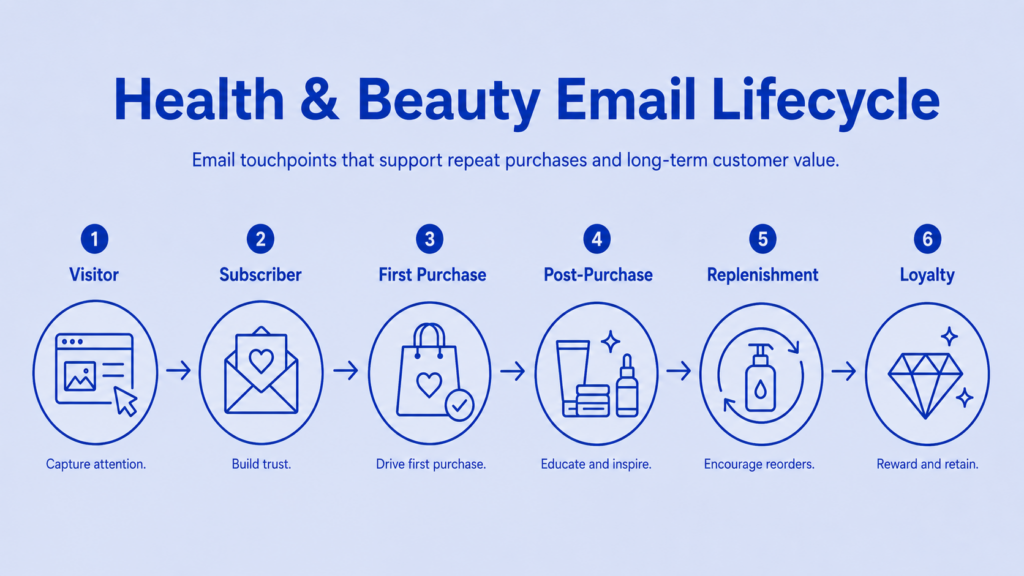
This is much stronger than campaign engagement, which makes sense. Flows are triggered by behavior or lifecycle events. A welcome flow reaches someone shortly after they show interest. A browse abandonment flow responds to product intent. A post-purchase flow reaches a customer while the product experience is still fresh. A replenishment flow reminds them when they may actually need to buy again.
For Health & Beauty brands, the most important flows usually include:
- Welcome flow
- Abandoned cart flow
- Browse abandonment flow
- Post-purchase education flow
- Replenishment flow
- Cross-sell flow
- Review request flow
- Winback flow
- VIP or loyalty flow
The best-performing brands often treat flows as a complete customer journey, not as isolated automations.
Email order rate and revenue per recipient: why averages are not the ceiling
The Health & Beauty email order rate benchmark is 0.09–0.12%, while revenue per recipient ranges from $0.10 to $0.18.
These averages are useful, but they should be interpreted carefully. Email performance can vary widely depending on list quality, segmentation, product type, deliverability, offer strength, customer loyalty, and how much revenue is already being captured by automated flows.
For Health & Beauty brands, email can often outperform the benchmark when the strategy is built around customer intent. A replenishment reminder sent at the right time will usually perform differently from a generic campaign. A post-purchase education sequence can increase satisfaction and reduce buyer’s remorse. A quiz-based welcome flow can recommend products more accurately than a standard discount pop-up.
The key point is simple: benchmark numbers show the middle of the market. They do not define what a well-executed account can achieve.
What stronger Health & Beauty brands do differently
Health & Beauty brands that outperform category averages usually have better systems across the full funnel.
They are not only better at ads, email, or CRO individually. They connect the pieces.
Strong brands usually have:
- Clear product positioning
- Better education before purchase
- Stronger product pages
- More persuasive reviews and proof
- Better creative testing
- Better post-purchase communication
- Replenishment logic
- Personalized product recommendations
- Stronger segmentation
- Consistent retention strategy
They also understand that Health & Beauty is not just a conversion category. It is a confidence category.
Customers want to feel they are making the right choice. The brand that gives them more clarity usually has an advantage.
Agency support worth comparing for Health & Beauty eCommerce brands
Health & Beauty brands often need specialist support because the category is competitive and execution details matter. However, the right agency depends on the bottleneck.
A brand with strong traffic but weak repeat purchase does not need the same partner as a brand with strong retention but poor acquisition. A brand with high cart abandonment may need CRO before scaling spend. A brand with weak creative may need a better testing system before increasing the budget.
If your Health & Beauty brand is underperforming in one of these areas, compare specialist eCommerce agencies by service, or take a look at all the listed agencies with a strong focus on the Health & Beauty industry before choosing a partner.
5 agency types Health & Beauty brands may need in 2026
1. Email marketing and retention agency
This type of agency is useful when the brand has traffic, customers, and repeat purchase potential, but is not getting enough value from email, SMS, flows, segmentation, and lifecycle marketing.
For Health & Beauty, this can include welcome flows, post-purchase education, replenishment reminders, cross-sell flows, winback campaigns, and loyalty-focused communication.
2. Paid social agency
A paid social agency can help brands improve Meta and TikTok performance through creative testing, campaign structure, audience strategy, and acquisition analysis.
This is especially useful for Health & Beauty brands that need better ad angles, stronger UGC, and more consistent creative output.
3. Google Ads agency
A Google Ads agency is useful for brands with strong search demand, multiple SKUs, Shopping campaigns, or a need to separate branded and non-branded performance more clearly.
For Health & Beauty brands, Google can be especially important when customers search by concern, ingredient, product type, or brand comparison.
4. CRO agency
A CRO agency can help improve product pages, landing pages, quizzes, bundles, checkout flow, reviews, FAQs, and trust signals.
This is important because Health & Beauty customers often need reassurance before buying. Better conversion does not always come from more aggressive offers. Sometimes it comes from better explanation.
5. Creative strategy agency
A creative strategy agency can help brands produce better ad concepts, creator briefs, UGC systems, product demonstrations, education-led content, and testing frameworks.
This matters because Health & Beauty is highly visual, but visual content alone is not enough. The creative needs to explain the product, build trust, and make the benefit easy to understand.
Where Health & Beauty brands should focus in 2026
Health & Beauty brands should focus on four main areas in 2026.
First, they need to improve trust before purchase. This includes better reviews, clearer product education, stronger guarantees, transparent ingredients, and more useful product pages.
Second, they need to connect acquisition and retention. Paid ads should not be judged only by first-purchase ROAS if the category has strong repeat purchase potential.
Third, they need to treat email and lifecycle marketing as a growth channel, not just a promotional channel. Health & Beauty customers need reminders, routines, education, and personalized recommendations.
Fourth, they need to build a better creative system. Meta, TikTok, and even landing pages depend on strong messaging and constant testing.
The main point for 2026 is that Health & Beauty brands still have strong demand to work with, but customers need more reasons to believe. The brands that win will not necessarily be the ones shouting the loudest or discounting the hardest. They will be the ones that make the buying decision easier through education, proof, relevant creative, and better post-purchase communication, which is also supported by NIQ’s State of Beauty research around digital growth, eCommerce acceleration, and changing beauty purchase behavior.
Final takeaway
Health & Beauty eCommerce has strong fundamentals. The category has a high conversion benchmark, meaningful AOV range, solid LTV potential, and repeat purchase rates that many other industries would like to have.
But the same category is also crowded, trust-sensitive, and increasingly dependent on execution quality.
The benchmark numbers show what average performance can look like:
- 4.5–4.6% conversion rate
- $60–$164 AOV
- $220–$380 estimated 12-month LTV
- 35–50% repeat purchase rate
- 3.0–3.5x Meta ROAS
- 2.8–3.8x Google ROAS
- 3.2–3.5x TikTok ROAS
- 30.5% campaign open rate
- 46–54% flow open rate
For Health & Beauty brands, the opportunity is not just to match these numbers. It is to understand where the brand is underperforming, then improve the systems behind the numbers.
The brands that win in 2026 will likely be the ones that combine strong creative, clear education, high-trust product pages, and lifecycle marketing that keeps customers coming back after the first order.
FAQ: Health & Beauty eCommerce benchmarks
How can Health & Beauty brands improve their conversion rate above the industry average?
Health & Beauty brands can improve conversion rate by reducing uncertainty before the customer reaches checkout. In this category, people often hesitate because they are unsure whether the product is right for their skin, hair, routine, goal, or concern.
The biggest improvements usually come from stronger product pages. Instead of only listing benefits, brands should explain who the product is for, how it works, when to use it, what results to expect, and how it fits into a wider routine. Reviews, before-and-after content where appropriate, ingredient explanations, customer FAQs, guarantees, and product comparison sections can all help shoppers feel more confident.
Quizzes can also help when the product catalog is broad. A skincare, wellness, or hair care brand with many similar products may convert better when shoppers are guided toward the right product instead of being left to compare everything on their own.
What can Health & Beauty brands do to increase AOV without relying on discounts?
The best way to increase AOV in Health & Beauty is to make the larger order feel more useful, not just cheaper.
Instead of only using discount thresholds, brands can build routine-based bundles, starter kits, replenishment packs, “complete your routine” sections, and product recommendations based on customer goals. For example, a skincare brand can group cleanser, serum, and moisturizer into a simple routine. A hair care brand can pair shampoo, conditioner, and treatment products. A wellness brand can create monthly supply bundles around a specific goal.
This works because customers are often not buying one isolated product. They are trying to solve a problem or build a routine. When the bundle helps them do that more clearly, the higher order value feels natural.
How can Health & Beauty brands reduce cart abandonment?
Health & Beauty brands can reduce cart abandonment by treating it as a confidence problem, not only a discount problem.
Many shoppers abandon carts because they still have unanswered questions. They may be unsure about product fit, ingredients, shipping costs, delivery speed, return policy, or whether the product is worth trying. A stronger cart experience should address those doubts before the customer leaves.
That can include clearer shipping information, visible reviews near checkout, trust badges, easy returns, product guarantees, and reminders of the product’s main benefit. Abandoned cart emails and SMS should also do more than repeat the product image. They should reinforce why the product was relevant, answer common objections, and bring back social proof.
Discounts can work, but they should not be the only tool. If every abandoned cart is solved with a discount, customers may learn to wait.
How can Health & Beauty brands get better results from email marketing?
Health & Beauty brands usually get better email marketing results when they move beyond generic campaigns and build around the customer lifecycle.
The most important starting point is segmentation. A subscriber interested in skincare should not always receive the same campaigns as someone interested in hair care, supplements, or makeup. First-time buyers, repeat customers, VIP customers, replenishment-ready customers, and discount-only buyers should also be treated differently.
Flows are especially important in this category. Welcome flows can educate new subscribers. Post-purchase flows can explain how to use the product properly. Replenishment flows can bring customers back at the right time. Cross-sell flows can introduce the next logical product in the routine. Winback flows can recover customers who have not purchased again.
The brands that outperform average email benchmarks usually use email as a guided experience, not just a broadcast channel.
How should Health & Beauty brands judge paid ads performance beyond ROAS?
Health & Beauty brands should judge paid ads by how well acquisition connects to the rest of the business, not only by platform ROAS.
ROAS is useful, but it can be misleading if viewed alone. A campaign with a lower first-purchase ROAS may still be valuable if it brings in customers with high repeat purchase potential. A campaign with a high ROAS may be less impressive if most revenue comes from existing customers, branded search, or low-margin products.
Brands should look at CAC, AOV, gross margin, first-order profitability, repeat purchase rate, subscription rate, and 12-month LTV. They should also separate new customer acquisition from returning customer revenue where possible.
For Health & Beauty brands, the best paid ads strategy is usually not just “get the cheapest purchase.” It is “acquire the right customer, then have the retention system to make that acquisition profitable over time.”