
Food & Beverage eCommerce in 2026: from one-time trial to buying habit
Food & Beverage is one of the more interesting eCommerce categories going into 2026 because it sits between necessity, convenience, taste, lifestyle, and routine.
Unlike categories where customers may buy once and disappear for years, Food & Beverage has a natural repeat purchase path. People finish products. They reorder products they like. They develop preferences. They buy around routines, occasions, health goals, gifting moments, and household habits.
That makes the category attractive, but it also creates a different kind of pressure. A Food & Beverage brand does not only need to get someone to try the product once. It needs to turn that trial into a habit.
That is where many brands struggle.
The first purchase may come from a strong ad, a discount, an influencer mention, or product curiosity. The second, third, and fourth purchases usually require something deeper: product satisfaction, timing, replenishment, relevance, and a reason to keep buying from the same brand instead of switching to a cheaper or more convenient option.
Food and beverage eCommerce is also benefiting from broader shifts in online grocery, direct-to-consumer brands, meal kits, specialty diet products, and convenience-led buying behavior. The continued expansion of online food and beverage shopping is also visible in The Business Research Company’s food and beverages eCommerce market analysis, where digital ordering, DTC food brands, and convenience-driven behavior remain key growth factors.
That context matters because the Food & Beverage benchmark profile looks strong on the surface: high conversion rate, strong repeat purchase rate, and relatively low cart abandonment compared with many other categories. But because AOV is lower, margins can be tighter, and products are often replenishable, growth depends heavily on how well the brand builds repeat purchase behavior after the first order.
What makes Food & Beverage different from other eCommerce categories
Food & Beverage behaves differently from many eCommerce categories because the product is consumed, replaced, and often shared.
A customer buying skincare may be solving a personal concern. A customer buying apparel may be choosing a style. A customer buying electronics may be making a considered investment. But a Food & Beverage customer is often buying something that fits into daily life: breakfast, coffee, protein, snacks, alcohol, meal preparation, gifting, entertaining, wellness, or household routines.
That creates four important differences.
First, taste matters. A product can have strong branding and still fail if customers do not enjoy it enough to reorder.
Second, timing matters. Replenishment windows are often predictable, but only if the brand understands usage frequency.
Third, convenience matters. Customers may like a product, but if reordering is difficult, slow, or poorly timed, they may switch.
Fourth, margins matter. Many Food & Beverage brands operate with lower AOVs, shipping complexity, heavier products, cold-chain issues, or wholesale competition. That means acquisition cannot be judged only by first-order revenue.
The brands that win in this category usually understand that the first order is only the start of the relationship.
Food & Beverage benchmark summary for 2026
General Food & Beverage benchmarks
| KPI | Food & Beverage benchmark |
|---|---|
| Conversion rate | 6.1–6.2% |
| Average order value | $65–$75 |
| LTV, 12-month estimate | $200–$360 |
| Cart abandonment | 63.6% |
| CAC estimate | $20–$40 |
| Repeat purchase rate | 45–65% |
Paid ads benchmarks
| Channel | ROAS | CPA |
|---|---|---|
| Meta Ads | 2.0–3.0x | $25–$38 |
| Google Ads | 3.0–4.0x | $18–$28 |
| TikTok Ads | 1.8–2.5x | $22–$35 |
Email marketing benchmarks
| KPI | Food & Beverage benchmark |
|---|---|
| Campaign open rate | 31.2% |
| Campaign CTR | 1.5–2.2% |
| Flow open rate | 50–56% |
| Flow CTR | 5.5–8.5% |
| Email order rate | 0.12–0.18% |
| Revenue per recipient | $0.08–$0.14 |
Methodology note: These benchmarks are directional ranges based on publicly available eCommerce benchmark reports, platform-level performance data, category research, and agency observations. They should be used as planning benchmarks, not fixed performance targets.
These numbers show a category with strong purchase intent and meaningful retention upside. The challenge is that lower AOV makes every part of the funnel more sensitive. A small improvement in repeat purchase rate, replenishment timing, or email revenue can have a major impact on profitability.
General benchmarks: strong conversion, lower AOV, and high repeat purchase potential
Food & Beverage has one of the strongest general benchmark profiles among the 12 eCommerce industries.
The conversion rate is high. Cart abandonment is relatively low. Repeat purchase rate is one of the strongest in the benchmark set. LTV is meaningful compared with the initial order value.
But the category also has a clear limitation: AOV.
With an average order value between $65 and $75, Food & Beverage brands often do not have the same room for inefficient acquisition as premium categories. A brand selling a $300 product can absorb more friction in the first purchase than a brand selling snacks, drinks, pantry products, or consumables at a lower basket size.
This does not make the category weaker. It simply changes how performance should be judged.
Food & Beverage brands need to think less like one-time transaction businesses and more like repeat-order businesses. The first order introduces the product. The real value comes from reorder behavior, subscriptions, bundles, household replenishment, and product discovery over time.
Why Food & Beverage conversion rates are among the strongest in eCommerce
The Food & Beverage conversion rate benchmark sits at 6.1–6.2%, which is higher than most categories in the benchmark set.
This makes sense. Many Food & Beverage purchases are practical and lower-friction. Customers often understand the product quickly. They know what coffee, snacks, protein powder, tea, wine, sauces, ready meals, or beverages are supposed to do. The product does not always require a long explanation before the customer can decide.
There is also a strong emotional layer. Taste, cravings, convenience, health goals, gifting, social occasions, and personal rituals all influence buying behavior.
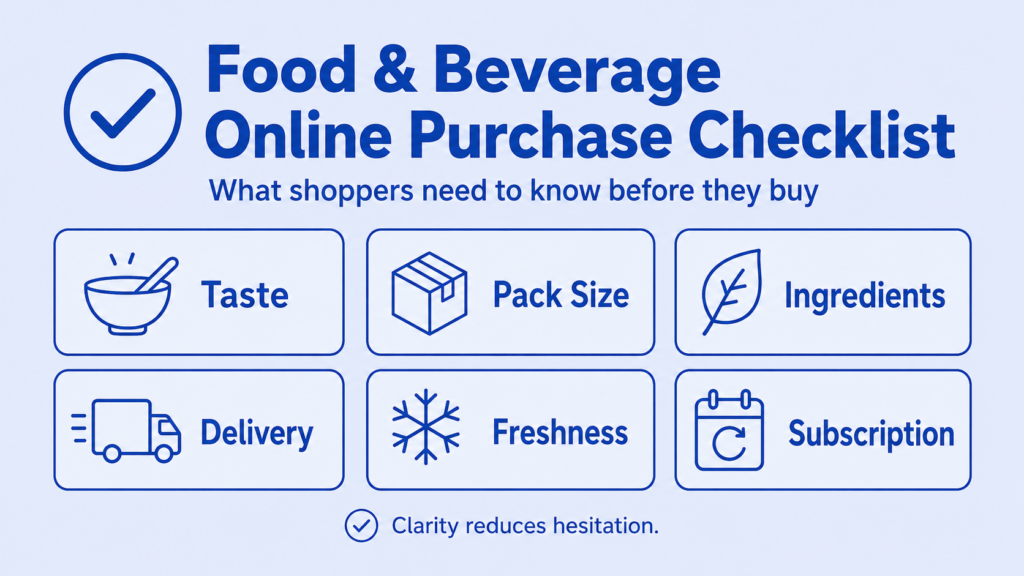
Still, a strong conversion benchmark should not make brands complacent. Conversion can drop quickly when the product page does not answer basic questions: flavor, size, ingredients, usage, delivery, freshness, storage, dietary fit, or shipping cost.
For Food & Beverage brands, conversion often improves when the product page makes the decision feel simple. What does it taste like? Who is it for? When would someone use it? How much comes in the pack? How long will it last? Is it better as a one-time purchase, bundle, or subscription?
Those answers matter because Food & Beverage buying decisions are often fast, but they still require confidence.
The AOV challenge: why small baskets can limit growth even when demand is strong
The Food & Beverage AOV benchmark is $65–$75.
This is not necessarily bad. A lower AOV can help reduce purchase friction and make the first order easier. The problem is that lower AOV also limits how much a brand can spend to acquire each customer.
If the first order is small, paid acquisition needs either strong margins, high repeat purchase, or a clear path to higher customer value. Otherwise, growth can look good on the surface but become difficult to sustain.
That is why Food & Beverage brands often need stronger merchandising than they realize.
AOV can improve through:
- Variety packs
- Starter kits
- Replenishment bundles
- Subscription-first offers
- Multi-packs
- Gift boxes
- Occasion-based bundles
- Free shipping thresholds
- Cross-sell recommendations
The key is to make the larger order feel useful. A “stock up and save” offer can work, but only if the customer already understands the product. For first-time buyers, variety packs and trial bundles may work better because they reduce risk while still increasing basket size.
Repeat purchase is the real business model in Food & Beverage
Food & Beverage repeat purchase rate ranges from 45% to 65%, which is one of the strongest signals in the entire benchmark set.
This is where the category has real upside.
A customer who likes the product can reorder naturally. They may buy the same product again, try another flavor, move into a subscription, send it as a gift, or add it to a regular household routine.
But repeat purchase does not happen just because the product is consumable. The brand needs to create the conditions for it.
The customer needs to remember the brand. They need to be reminded at the right time. They need to trust the reorder experience. They need to feel that buying directly from the brand is better than buying from a marketplace, retailer, or local store.
This is where retention systems matter. Replenishment emails, subscription prompts, post-purchase education, product pairings, flavor discovery, loyalty rewards, and winback campaigns can all help turn a first purchase into a repeated behavior.
Food & Beverage trends are also moving toward more specific consumer needs: health benefits, digestive health, protein, indulgence, affordability, sustainability, and product pricing all sit together in purchase decisions, a pattern also reflected in Innova Market Insights’ 2026 food and beverage trend analysis.
That makes the retention opportunity more nuanced. Customers are not only reordering “food.” They are reordering products that fit a lifestyle, budget, diet, routine, or occasion.
Why cart abandonment is lower than many categories, but still worth optimizing
Food & Beverage cart abandonment sits at 63.6%, which is lower than many other eCommerce categories.
This suggests that once customers reach the cart, they may be more ready to buy than shoppers in higher-consideration industries. The product is usually easier to understand, the order value is lower, and the decision feels less risky.
But 63.6% still means many carts are not completed.
For Food & Beverage, abandonment often comes down to practical friction:
- Shipping cost
- Delivery speed
- Minimum order value
- Cold-chain or freshness concerns
- Subscription confusion
- Lack of dietary clarity
- Unclear pack size
- Weak value perception
- Discount expectations
A strong cart and checkout experience should make the order feel easy. That means clear shipping rules, visible delivery timelines, simple subscription terms, pack-size clarity, and reassurance around freshness or product quality where relevant.
Abandoned cart flows should also be specific. A generic “you left something behind” message is weaker than one that reinforces the product use case, reminds the customer of the bundle value, answers common objections, or adds urgency around delivery windows.
Paid ads benchmarks for Food & Beverage brands
Paid ads in Food & Beverage are shaped by a simple tension: the category has strong demand, but the economics can be tight.
The benchmark data shows that Google has the strongest ROAS range, Meta is useful but more variable, and TikTok has lower benchmark ROAS than the other two channels.
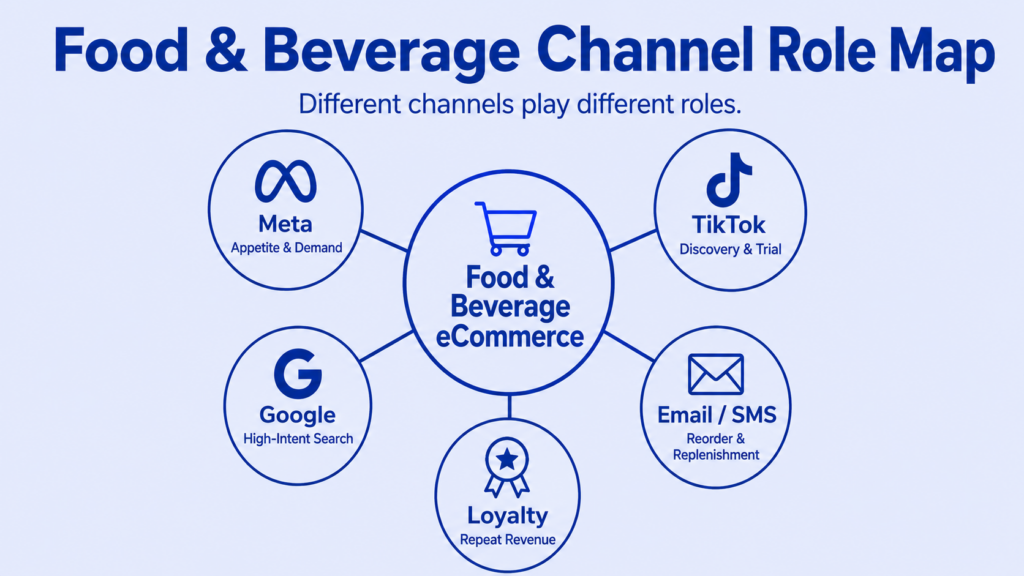
That does not mean one channel is always better. It means each channel plays a different role.
Google captures intent. Meta builds demand and retargets interest. TikTok creates discovery and trial, especially for products with strong visual, sensory, or creator-led appeal.
Meta Ads: making taste, convenience, and lifestyle visible
| KPI | Benchmark |
|---|---|
| Meta ROAS | 2.0–3.0x |
| Meta CPA | $25–$38 |
Meta can work well for Food & Beverage, but the creative has to do a lot of work.
Unlike search, where shoppers may already know what they want, Meta often needs to create interest quickly. The ad has to make the product feel desirable, easy to understand, and worth trying.
The strongest creative angles often focus on:
- Taste and texture
- Convenience
- Health or dietary fit
- Occasions
- Family or household use
- Gifting
- Comparison against alternatives
- Social proof
- Subscription value
- Limited seasonal flavors or drops
Food & Beverage brands should be careful with creative that only shows the product packaging. Packaging matters, but it rarely does the full selling job by itself. The customer needs to understand when they would use the product and why it deserves a place in their routine.
Google Ads: capturing shoppers already searching for products, occasions, or alternatives
| KPI | Benchmark |
|---|---|
| Google ROAS | 3.0–4.0x |
| Google CPA | $18–$28 |
Google has the strongest ROAS range for Food & Beverage in this benchmark set. That is likely because many searches already carry intent.
A shopper may search for a product type, flavor, dietary need, gift, brand, subscription, or alternative. That intent is valuable because the customer is already trying to solve a need.
Google can be especially important for Food & Beverage brands in categories like specialty coffee, protein, functional beverages, wine and spirits, meal kits, snacks, functional foods and nutrition-led products, pantry products, and dietary-specific products.
However, brands still need to separate the quality of demand. Branded search, non-branded search, Shopping, Performance Max, and competitor terms can all produce very different results. A blended Google ROAS may look strong while hiding overdependence on branded demand.
A better question is: is Google helping the brand capture new demand, defend existing demand, or simply collect sales that would have happened anyway?
TikTok Ads: turning product discovery into trial
Food & Beverage TikTok Ads benchmarks sit at:
| KPI | Benchmark |
|---|---|
| TikTok ROAS | 1.8–2.5x |
| TikTok CPA | $22–$35 |
TikTok can be powerful for Food & Beverage because the platform is naturally built for discovery. Taste tests, recipes, preparation rituals, unboxings, creator reactions, and “how I use it” videos can make a product feel more tangible than a static product page.
But TikTok can also be difficult to scale profitably. The benchmark ROAS range is lower than Google and Meta, which suggests that many brands may use TikTok more effectively as a discovery and trial channel than as a pure last-click revenue channel.
The best Food & Beverage TikTok creative usually feels native. It shows the product in context. It makes the taste, texture, convenience, or occasion easy to imagine. It does not rely only on polished product shots.
Food and beverage demand is also becoming more influenced by flavor experimentation, functional benefits, and culturally inspired formats, which can also be seen in Tastewise’s 2026 food and beverage trend forecast around transparency, functional foods, sustainability-focused ingredients, and flexible meal formats.
That gives TikTok a natural role: it can help new products, flavors, and rituals become visible before shoppers are actively searching for them.
Why lower AOV changes how Food & Beverage brands should read ROAS
Food & Beverage CAC ranges from $20 to $40.
At a $65–$75 AOV, that CAC range can be workable, but only if margins and repeat purchase support it.
A 2.5x ROAS can mean very different things depending on whether customers reorder within 30 days, subscribe after the first purchase, buy bundles, or disappear after the trial order.
That is why Food & Beverage brands should judge paid ads through a customer value lens, not only platform ROAS.
Important questions include:
- What percentage of paid customers buy again?
- How long does it take to reach the second order?
- Which product has the best first-to-second purchase path?
- Are subscriptions improving payback?
- Are bundles creating better customer quality?
- Is paid social bringing new customers or mostly retargeting existing demand?
For Food & Beverage brands, paid ads work best when acquisition is connected to the retention system. The ad gets the first order. Email, SMS, product experience, replenishment, and loyalty create the profit.
Email marketing benchmarks for Food & Beverage brands
Email is especially important in Food & Beverage because the category depends on repeat purchase.
The benchmark data shows:
| KPI | Food & Beverage benchmark |
|---|---|
| Campaign open rate | 31.2% |
| Campaign CTR | 1.5–2.2% |
| Flow open rate | 50–56% |
| Flow CTR | 5.5–8.5% |
| Email order rate | 0.12–0.18% |
| Revenue per recipient | $0.08–$0.14 |
The most important thing here is the gap between campaigns and flows. Campaigns are useful for launches, seasonal promotions, content, bundles, and offers. Flows are where timing can become a competitive advantage.
A customer who bought coffee three weeks ago, protein one month ago, or wine before a holiday period should not be treated the same as someone who has never purchased.
Food & Beverage email marketing works best when it reflects consumption behavior.
Campaign performance: why frequency matters more than occasional promotions
The average Food & Beverage campaign open rate is 31.2%, with CTR between 1.5% and 2.2%.
That is a healthy starting point, but Food & Beverage brands can often make campaigns more valuable by moving away from generic broadcast calendars.
Food & Beverage campaigns can be built around:
- New flavors
- Seasonal products
- Replenishment reminders
- Recipes and usage ideas
- Pairings
- Gift moments
- Subscription benefits
- Customer favorites
- Limited batches
- Stock-up periods
- Health or lifestyle goals
Frequency matters because Food & Beverage is a routine-driven category. A brand that only emails during promotions may train customers to wait for discounts. A brand that mixes product education, usage ideas, seasonal relevance, and reorder prompts has more chances to stay present without sounding repetitive.
Automated flows: the strongest opportunity for replenishment and routine-building
Food & Beverage flow open rates sit between 50% and 56%, while flow CTR ranges from 5.5% to 8.5%.
These are strong numbers, and they make sense. Flows are usually closer to customer intent than campaigns.
The most important Food & Beverage flows often include:
- Welcome flow
- Abandoned cart flow
- Browse abandonment flow
- Post-purchase education flow
- Replenishment flow
- Subscription conversion flow
- Cross-sell flow
- Review request flow
- Winback flow
- VIP or loyalty flow
The replenishment flow is especially important. If a brand knows when a customer is likely to run out of a product, the reminder can arrive at the exact moment it is useful.
This is where email becomes more than a promotional channel. It becomes part of the customer’s buying rhythm.
Email order rate and revenue per recipient: why small improvements compound quickly
Food & Beverage email order rate ranges from 0.12% to 0.18%, while revenue per recipient sits between $0.08 and $0.14.
At first glance, revenue per recipient may look modest. But in Food & Beverage, small improvements can compound quickly because orders are repeatable.
A small lift in replenishment flow performance can affect revenue every month. A better welcome flow can improve the quality of first-time buyers. A stronger post-purchase flow can increase the chance of a second order. Better segmentation can protect list health and keep engagement higher over time.
This is why Food & Beverage email strategy should not be judged only by one campaign. The bigger question is whether the program increases order frequency, repeat purchase, subscription adoption, and customer lifetime value.
Why average email benchmarks are not the ceiling
The Food & Beverage benchmark campaign open rate is 31.2%, but that should be treated as a baseline, not a limit.
Email performance can move far above the average when deliverability, list hygiene, segmentation, design, and flow architecture are handled properly. A useful example is Retention Side’s Hedonism Wines case study, where a wine and spirits retailer moved from a broad Mailchimp setup to a more structured Klaviyo program, including list hygiene, deliverability recovery, product-interest segmentation, redesigned emails, and flow architecture. After the engagement began, average open rates reached 79.65%, and email revenue increased by over 500%, according to the case study.
The reason this example matters is not only the final number. It shows why benchmarks are not the ceiling. In Food & Beverage and adjacent categories, customer preferences can be very specific. Someone interested in rare wine, specialty coffee, functional beverages, vegan snacks, protein products, or premium pantry items should not receive the same email experience as every other subscriber.
Relevance changes the economics.
What better Food & Beverage brands do differently
Food & Beverage brands that outperform category averages usually build around habit, not just traffic.
They do not rely only on ads to create growth. They build a system where the first purchase leads naturally into the second.
Strong brands usually have:
- Clear first-order offer
- Strong product page explanation
- Easy bundle or variety-pack logic
- Replenishment timing
- Subscription or repeat-order path
- Product education after purchase
- Segmented campaigns
- Email flows based on consumption behavior
- Loyalty or referral mechanics
- Paid ads connected to LTV, not only first-order ROAS
The best Food & Beverage brands also understand that customers need reasons to reorder before they run out, not after they have already switched.
5 agency types Food & Beverage brands may need in 2026
1. Retention and lifecycle marketing agency
Food & Beverage brands often have strong repeat purchase potential, but many do not have a structured system for turning first-time buyers into regular customers.
A lifecycle and replenishment agency can help build welcome flows, post-purchase education, reorder reminders, subscription prompts, winback flows, and product-specific customer journeys.
This is especially useful for brands selling consumables such as coffee, protein, snacks, beverages, pantry items, supplements-adjacent foods, or premium alcohol, where timing and preference matter more than generic promotion.
2. Subscription and loyalty agency
Many Food & Beverage brands can benefit from subscriptions, but only when the offer is built carefully. A poorly positioned subscription can feel like a commitment too early, especially before the customer knows whether they like the product.
A subscription and loyalty agency can help structure trial-to-subscription journeys, loyalty programs, reorder incentives, referral programs, and VIP customer experiences.
This type of support is useful when the brand already has repeat buyers but wants to increase order frequency, reduce churn, and make recurring revenue more predictable.
3. Marketplace and retail media agency
Food & Beverage brands often do not grow through their own website alone. Many customers discover or reorder through Amazon, Instacart, Walmart, Target, grocery delivery platforms, or retail media networks.
A marketplace and retail media agency can help brands manage product listings, retail media campaigns, marketplace advertising, review generation, product visibility, and channel-specific conversion.
This is especially relevant for brands that sell both DTC and through retail partners, because customers may discover the brand on one channel and repurchase on another.
4. Offer and merchandising agency
Because Food & Beverage AOV is usually lower, offer structure matters a lot. The wrong offer can create low-margin customers. The right offer can increase basket size while making the purchase decision easier.
An offer and merchandising agency can help build starter kits, variety packs, multi-packs, subscription bundles, gift boxes, seasonal collections, stock-up offers, and free shipping thresholds.
This kind of support is useful when traffic is decent, but AOV, bundle adoption, or first-to-second purchase behavior is weaker than expected.
5. Content and creator agency
Food & Beverage products are hard to evaluate online because customers cannot taste, smell, or experience them before buying.
A content and creator commerce agency can help make the product more tangible through taste tests, recipes, preparation videos, pairing ideas, creator reviews, UGC, product education, and short-form video concepts.
This is especially important for TikTok, Meta, influencer campaigns, and landing pages, where the creative needs to make the product feel desirable before the customer has tried it.
Compare specialist eCommerce agencies for Food & Beverage brands based on service focus, channel expertise, and category experience.
Where Food & Beverage brands should focus next
Food & Beverage brands should focus on five areas in 2026.
First, make the first order easier. This can come from starter kits, variety packs, clear product education, simple subscription options, or stronger product pages.
Second, improve the second-order path. A customer who buys once but never again is often not a profitable customer. Brands should build post-purchase flows, replenishment reminders, product recommendations, and loyalty prompts around the expected consumption cycle.
Third, connect paid ads to LTV. ROAS alone does not tell the full story in a lower-AOV category. The real question is whether paid customers come back.
Fourth, use email as a retention engine. Food & Beverage customers are highly responsive to timing, preference, and routine-based messaging. Generic campaigns leave too much value on the table.
Fifth, keep product discovery active. Customers may like one product and still need guidance toward the next flavor, bundle, format, or occasion.
The broader market is moving toward a mix of health, pleasure, affordability, convenience, and sustainability, which also appears across Innova’s 2026 food and beverage trends. For eCommerce brands, that means the winning strategy is unlikely to be only “sell more products.” It is more likely to be “fit more naturally into the customer’s lifestyle.”
Key takeaway
Food & Beverage eCommerce has strong fundamentals.
The category has a high conversion rate, strong repeat purchase potential, lower-than-average cart abandonment, and a natural path toward recurring revenue. But the lower AOV means brands have less room for inefficient acquisition and weak retention.
The benchmark numbers show what average performance can look like:
- 6.1–6.2% conversion rate
- $65–$75 AOV
- $200–$360 estimated 12-month LTV
- 45–65% repeat purchase rate
- 2.0–3.0x Meta ROAS
- 3.0–4.0x Google ROAS
- 1.8–2.5x TikTok ROAS
- 31.2% campaign open rate
- 50–56% flow open rate
For Food & Beverage brands, the biggest opportunity is not just acquiring more first-time buyers. It is building a system that turns trial into habit.
The brands that win in 2026 will likely be the ones that make products easy to try, easy to reorder, easy to bundle, and easy to make part of everyday life.
FAQ: How Food & Beverage brands can beat average benchmarks
How can Food & Beverage brands improve repeat purchase rate?
Food & Beverage brands can improve repeat purchase rate by building around consumption timing. The brand needs to know when customers are likely to run out, when they are likely to reorder, and what product should come next.
For a coffee brand, that may mean a replenishment reminder based on bag size and average usage. For a snack brand, it may mean a variety-pack follow-up. For a beverage brand, it may mean a subscription prompt after the second order. For a wine or specialty food brand, it may mean product recommendations based on style, region, occasion, or previous purchase behavior.
The key is to avoid treating every buyer the same. Repeat purchase improves when reminders, recommendations, and offers match what the customer actually bought and how they are likely to use it.
How can Food & Beverage brands increase AOV without making the offer feel forced?
Food & Beverage brands can increase AOV by making larger baskets more useful, not just more discounted.
The best options are usually bundles, variety packs, multi-packs, subscription offers, gift boxes, and occasion-based collections. A customer may not want to randomly add more products to cart, but they may want a “starter pack,” “weekend hosting bundle,” “monthly supply,” “best-sellers box,” or “try every flavor” offer.
The offer should reduce decision-making, not create more of it. When the bundle helps the customer choose faster or get more value from the product, higher AOV feels natural.
How can Food & Beverage brands reduce cart abandonment?
Food & Beverage brands can reduce cart abandonment by removing practical friction.
In this category, abandonment often comes from shipping cost, delivery timing, minimum order value, product quantity confusion, freshness concerns, or unclear subscription terms. The checkout experience should answer those questions before the customer leaves.
Brands should make shipping thresholds visible, explain delivery timelines clearly, show what is included in the order, clarify subscription terms, and reinforce freshness or quality guarantees where relevant.
Abandoned cart flows should also be specific. Instead of only reminding the customer that they left something behind, the message can reinforce the product use case, highlight reviews, explain the bundle value, or answer common concerns.
How can Food & Beverage brands get better results from email marketing?
Food & Beverage brands get better email results when they build around timing, preference, and product behavior.
A strong email program should not only send campaigns for promotions. It should guide the customer from first interest to first purchase, then from first purchase to second purchase, replenishment, subscription, cross-sell, and loyalty.
The most important improvements usually come from segmentation, post-purchase education, replenishment flows, subscription prompts, winback flows, and product recommendations based on purchase history.
For example, a customer who bought a premium product may respond better to curation and education. A customer who bought a consumable staple may respond better to reorder timing. A customer who bought a variety pack may need guidance toward their next favorite product.
How should Food & Beverage brands judge paid ads performance when margins are tight?
Food & Beverage brands should judge paid ads by customer quality, not only by platform ROAS.
Because AOV is usually lower, a campaign may look weak on first purchase but become profitable if it brings in customers who reorder. At the same time, a campaign with strong ROAS may not be as valuable if it mostly captures existing customers, branded demand, or low-margin orders.
Brands should track CAC, AOV, gross margin, first-order profit, second purchase rate, subscription conversion rate, and 12-month LTV.
The goal is not only to buy the cheapest first order. The goal is to acquire customers who are likely to buy again.